
David: The Man We Keep Forgiving
We know David.
The shepherd who faced Goliath. The king who united a nation. The poet whose prayers and songs have given generations words for their own faith.
We remember his courage, his devotion, and his place in the story of God’s people.
And we know that David was not perfect.
We know about his failures. We know that he sinned. We know that God forgave him.
Perhaps we have become so accustomed to that story that we no longer feel its weight.
Because David’s story is not simply about a good man who made a mistake.
It is about a king who abused his power, caused real harm, and received mercy.
And that is where the scandal begins.
The Man Behind the Story
In 2 Samuel 11, David sees Bathsheba, the wife of Uriah, and summons her. This is where we begin, but what happens after will have lasting consequences…
She becomes pregnant.
David attempts to conceal what has happened. When his plans fail, he arranges for Uriah to be placed in the most dangerous part of the battle and abandoned.
Uriah dies.
David takes Bathsheba as his wife.
The story is deeply uncomfortable.
David is not simply a man who made a private mistake. He is a king who uses his power to take what he wants and then attempts to conceal the consequences.
Bathsheba is caught up in the actions of a powerful man. Uriah, a soldier serving his king, is betrayed and killed.
And the chapter ends with a simple but devastating statement: “The thing that David had done displeased the Lord.“
There is no attempt to soften what happened. No excuse offered for David. No suggestion that his faithfulness in other areas makes this acceptable.
David has done something profoundly wrong. And the people around him bear the cost!
The Man Who Is Confronted
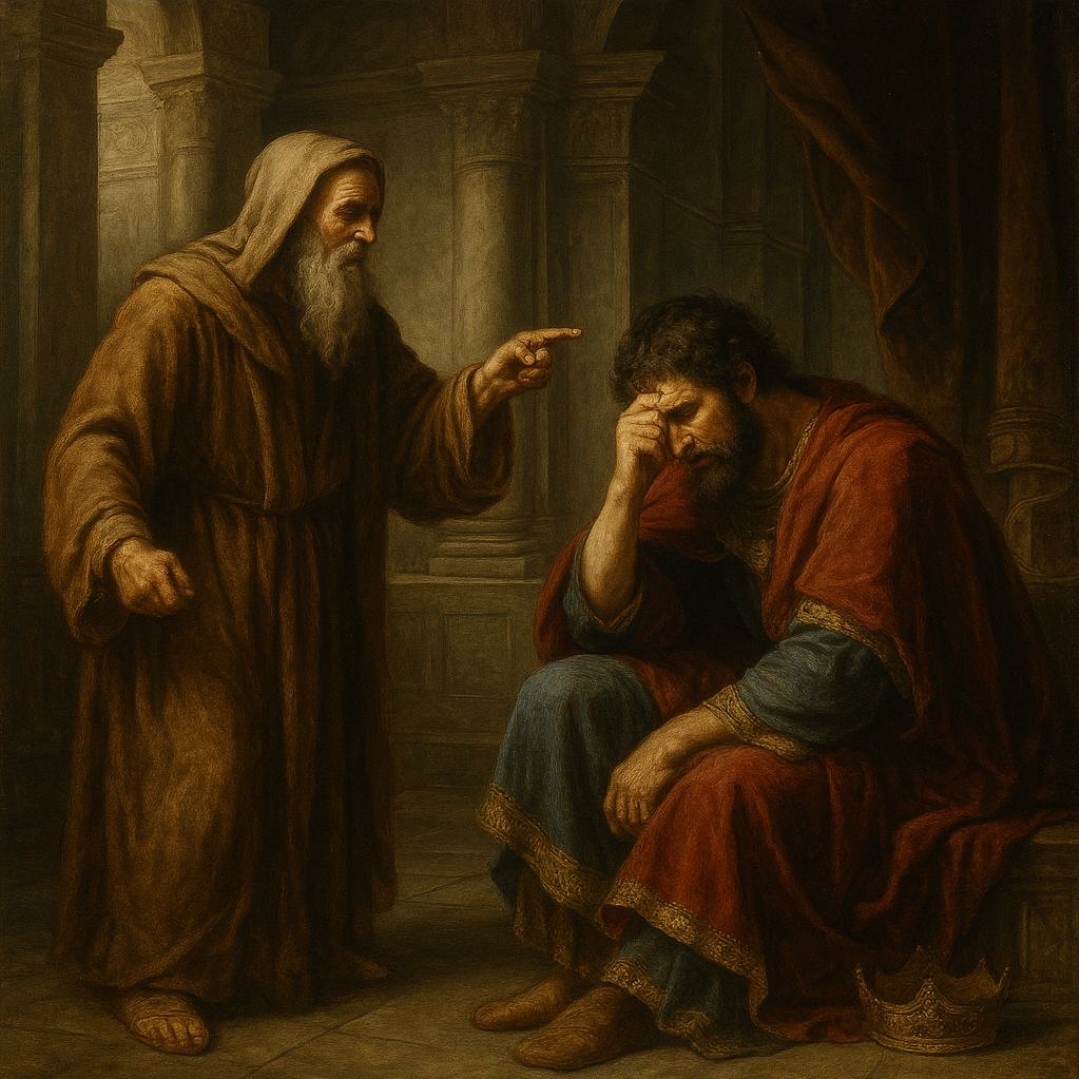
In the following chapter, the prophet Nathan comes to David.
He tells him a story about a rich man who takes a poor man’s beloved lamb, despite having plenty of his own.
David is outraged.
He recognises the injustice immediately. He is furious at the rich man’s actions.
And then Nathan says:
“You are the man!“
The story turns.
David can recognise injustice when it happens to someone else, but he has failed to recognise it in himself.
He can condemn the rich man’s actions while remaining blind to the harm he has caused.
Perhaps this is one of the most uncomfortable parts of David’s story.
How easily we recognise wrongdoing in others while finding reasons to excuse our own.
We see the harm others cause. We demand accountability. We become indignant when someone abuses their power.
But when the wrongdoing is ours, or belongs to someone we admire, the story can become more complicated.
We explain. We minimise. We look for reasons why it was not quite as bad as it seems.
David’s story invites us to examine that instinct.
Not only in the people we condemn.
But in ourselves.
The Man Who Receives Mercy
When Nathan confronts David, David confesses:
“I have sinned against the Lord.“
Nathan responds that the Lord has put away his sin and that David will not die.
The mercy is immediate.
But the consequences are not erased.
Nathan speaks of violence arising within David’s own household. And the chapters that follow tell of terrible suffering, including the violation of Tamar, the killing of Amnon, and Absalom’s rebellion against his father.
David’s household is torn apart.
The kingdom is shaken.
We should not, however, reduce every tragedy that follows to a simple punishment for David’s sin. The people involved make their own choices, they have their own agency, and their suffering deserves to be taken seriously in its own right.
But the larger truth remains:
David’s actions do not remain his alone.
They reach into the lives of others. They shape a family. They contribute to a story of violence and instability that extends beyond his own lifetime.
And that is something we sometimes forget when we speak about forgiveness.
Our actions are never ours alone.
The harm we cause can travel further than we imagine, affecting people who had no part in our choices.
And while we may receive forgiveness, those who have been harmed may still be living with the consequences.
The Discomfort of Grace
Here is where the story becomes difficult.
David is forgiven.
David remains king.
David continues to be remembered as a man of faith.
And we continue to tell his story.
There is something deeply unsettling about that, because if we were to ask those who suffered because of David’s actions, we might hear a very different story.
Uriah is dead. His family is left without him.
Bathsheba has lost her husband and later loses her child. We are not given a full account of her experience, and we should not pretend to know everything she felt or thought.
Her life continues, but the story of David’s repentance does not undo what happened to her.
And that matters.
Because when we speak of David’s forgiveness, we must not allow the person who caused the harm to become the only person whose story matters.
Grace does not make the suffering of others less significant.
It does not demand that those who have been harmed forgive, reconcile, or pretend that everything is well.
And it does not mean that a person’s repentance automatically restores every relationship or removes every consequence.
God’s mercy toward David does not erase the pain of those who suffered because of him.
That is the tension we must hold.
The Man We Keep Forgiving
And yet, Scripture does not reduce David to the worst thing he did.
His story continues.
He remains a deeply complicated figure: capable of faith and courage, but also of terrible wrongdoing; capable of repentance, but not spared the consequences of his actions.
We continue to remember him as more than his failures.
And perhaps that is a blessing.
Because if we were reduced entirely to the worst thing we had ever done, what hope would there be for any of us?
But there is a difference between saying that a person is more than their worst actions and pretending those actions do not matter.
David’s story refuses to let us do the latter.
His wrongdoing remains part of his story.
The people he harmed remain part of the story.
His repentance remains part of the story.
And so does God’s mercy.
Perhaps this is the scandal of grace: not that wrongdoing becomes insignificant, but that it does not necessarily have the final word over a person’s life.
The Question of Selective Outrage
David’s story also brings us back to a question that runs through this Lenten journey.
Who do we find it easy to forgive?
And who do we struggle to imagine receiving mercy?
We may be generous toward people we admire, people we identify with, or people whose stories we already know and love.
We may be far less generous toward those we have already decided are beyond redemption.
And sometimes, we are more forgiving of ourselves than we are of others.
David’s story unsettles those distinctions.
It asks whether we can acknowledge the full seriousness of someone’s wrongdoing without deciding that this must be the only thing that defines them.
And whether we can believe that a person may be changed, forgiven, and restored without pretending that the harm they caused never happened.
It also asks something closer to home:
Can we receive that same mercy for ourselves?
Can we tell the truth about the harm we have caused, take responsibility for it, and still believe that our story is not over?
More Than Our Worst Story
There is a blessing in not being reduced to our worst story.
There is hope in believing that failure does not have to define everything that follows.
But David’s story reminds us that our worst actions may become part of someone else’s story too.
And we cannot speak of our own restoration while forgetting those who have suffered because of us.
Grace does not ask us to minimise the harm.
It calls us to face it honestly.
To take responsibility.
To recognise that repentance is not simply about how we feel before God, but also about how we live with the people our actions have affected.
And still, grace leaves room for something we might struggle to imagine:
That even those who have caused real harm are not beyond the possibility of change.
That even those who have failed terribly may have a future beyond their failure.
That the story is not necessarily over.
Perhaps that is what makes grace so difficult to accept.
And perhaps that is what makes it so beautiful.
The Question That Remains
David’s story leaves us with difficult questions.
Can we hold someone accountable without reducing them to their worst actions?
Can we believe in the possibility of change without minimising the harm that has been done?
Can we extend mercy without confusing it with excusing wrongdoing?
And can we receive grace for ourselves while remaining honest about the people our choices have affected?
Perhaps the scandal of grace is that it refuses to let us settle for easy answers.
David’s story does not ask us to forget what he did.
It asks us to consider whether what he did must be the only thing that defines him.
And perhaps it asks us to consider the same thing about ourselves.
Scripture for Reflection
2 Samuel 12:1–13 (excerpt)
“You are the man!“
Read Nathan’s confrontation with David and notice how David responds when the injustice he condemns is revealed to be his own.
Psalm 51:1–12 (excerpt)
“Create in me a clean heart, O God, and put a new and right spirit within me.“
A prayer of confession and a longing for renewal.
If time allows, read:
- 2 Samuel 11:1–27
- 2 Samuel 12:1–25
- 2 Samuel 13:1–22
- 2 Samuel 15:1–14
Notice whose experiences are told, whose voices are heard, and whose suffering risks being overlooked.
A Practice for This Week
Take a little time to reflect on David’s story.
Then sit quietly and ask:
Where do we find it easier to recognise wrongdoing in others than in ourselves?
Are there times when we have excused our own actions while holding others to a different standard?
And where might our choices have affected people in ways we have not fully acknowledged?
Finally, consider this:
Can we believe that we are more than our worst actions while still taking responsibility for the harm we have caused?
You do not need to resolve every question.
Simply sit with what emerges, and bring it honestly before God.
Prayer
Merciful God,
you know the fullness of our stories.
You see the good we do, the harm we cause, and the things we struggle to face.
Forgive us where we have failed.
Open our eyes to the people affected by our choices.
Give us the courage to take responsibility, to seek forgiveness where it is needed, and to make right what we can.
Where we have been harmed, meet us with compassion.
Where we have caused harm, lead us towards repentance and change.
And when we are tempted to believe that our failures are the whole of our story, remind us that your mercy reaches further than we can imagine.
Form in us hearts that are honest, humble, and compassionate.
And teach us to hold together the truth of our wrongdoing and the hope of your grace.
Amen.
[…] Grace That Offends: A Seven-Part Devotional Series – Part 3 Reflection: John 21 – Calling Grace That Offends: A Seven-Part Devotional Series – Part 2 Reflection: Proverbs 30:5-9, Luke 9:1-6 Grace That Offends: A Seven-Part Devotional Series – Part 1 […]